HomeFeaturesPricingFree toolsFor accountantsBlogAbout
Start free trial Book a demo Log in

Compliance

The deductions KRA, URA, TRA and GRA expect, filed on time, every time.

PAYE, NSSF, SHIF, Affordable Housing Levy, SSNIT, SDL, WCF, LST and more. CromaHR calculates every statutory deduction correctly for Kenya, Uganda, Tanzania and Ghana, generates the returns, and keeps an audit trail your auditor can follow without a single phone call.

No card required · Free migration · Live in under a week

Tax compliance illustration
PAYE & income tax

Progressive bands, personal relief and insurance relief per country.

Social security

NSSF, SSNIT tiered contributions with employer and employee splits.

Health insurance

SHIF in Kenya, NHIF in Tanzania, deducted and remitted correctly.

Returns & filings

Auto-generated returns ready for submission to each authority.

Kenya

PAYE, NSSF, SHIF, AHL and NITA, all in one run.

Kenyan payroll has more moving parts than almost anywhere else on the continent. CromaHR handles the two-tier NSSF structure (Tier I capped at KES 540, Tier II at KES 5,940), SHIF at 2.75% with the KES 300 minimum, the Affordable Housing Levy at 1.5% above KES 24,000, and the NITA training levy of KES 50, all calculated automatically.

PAYE uses the current KRA bands: 10%, 25%, 30%, 32.5% and 35%, with personal relief of KES 2,400 and insurance relief of 15% capped at KES 5,000. Pension contributions up to KES 30,000 and mortgage interest up to KES 25,000 are deducted before tax. Persons with disabilities get the KES 150,000 exemption.

The NSSF, SHIF and AHL deductions are all pre-band deductions, they reduce chargeable pay before PAYE is computed. The system applies them in the correct order so you never over-tax or under-deduct.

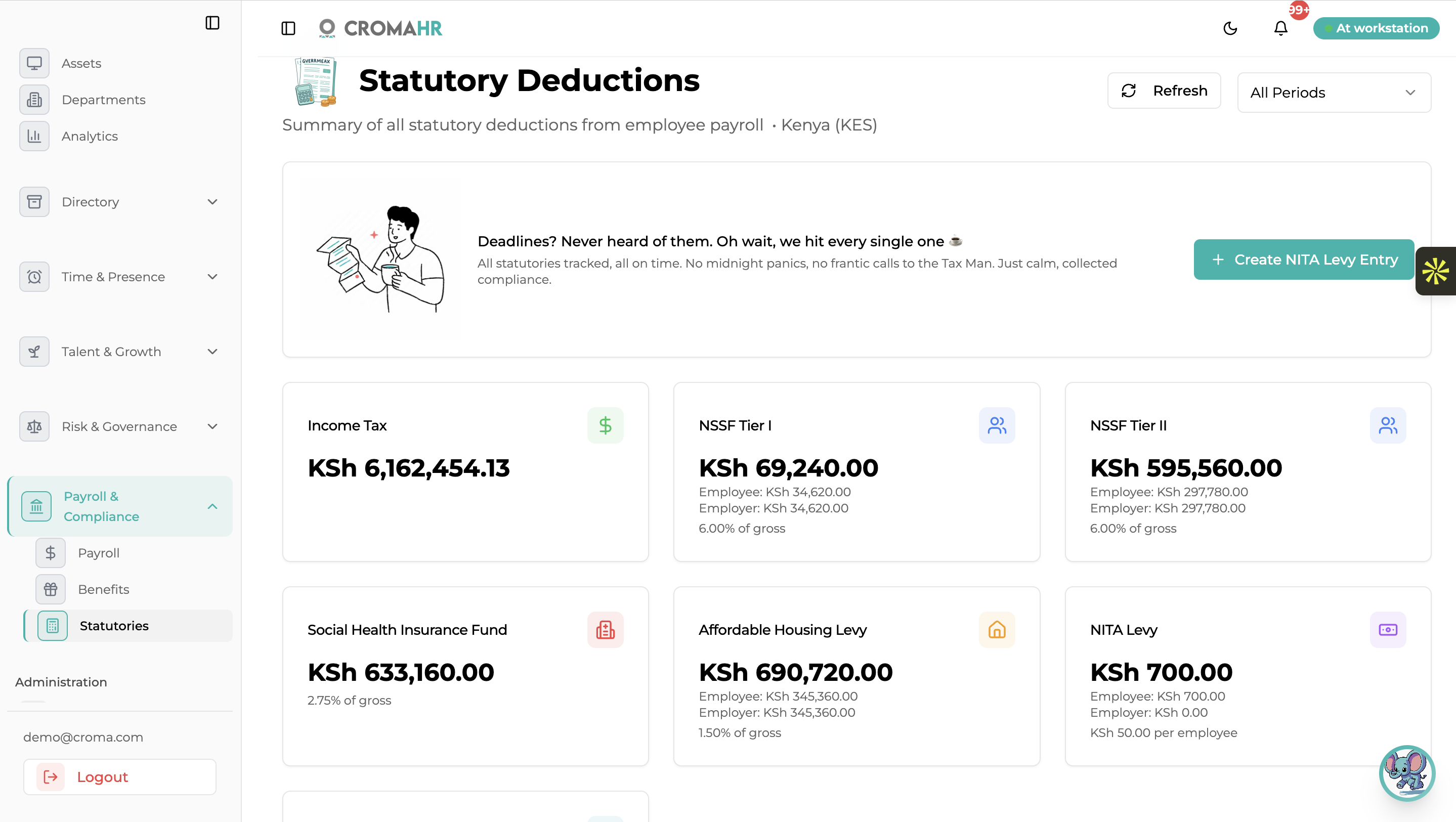
app.cromahr.com/payroll/kenya
Kenya statutory deductions in CromaHR

Uganda

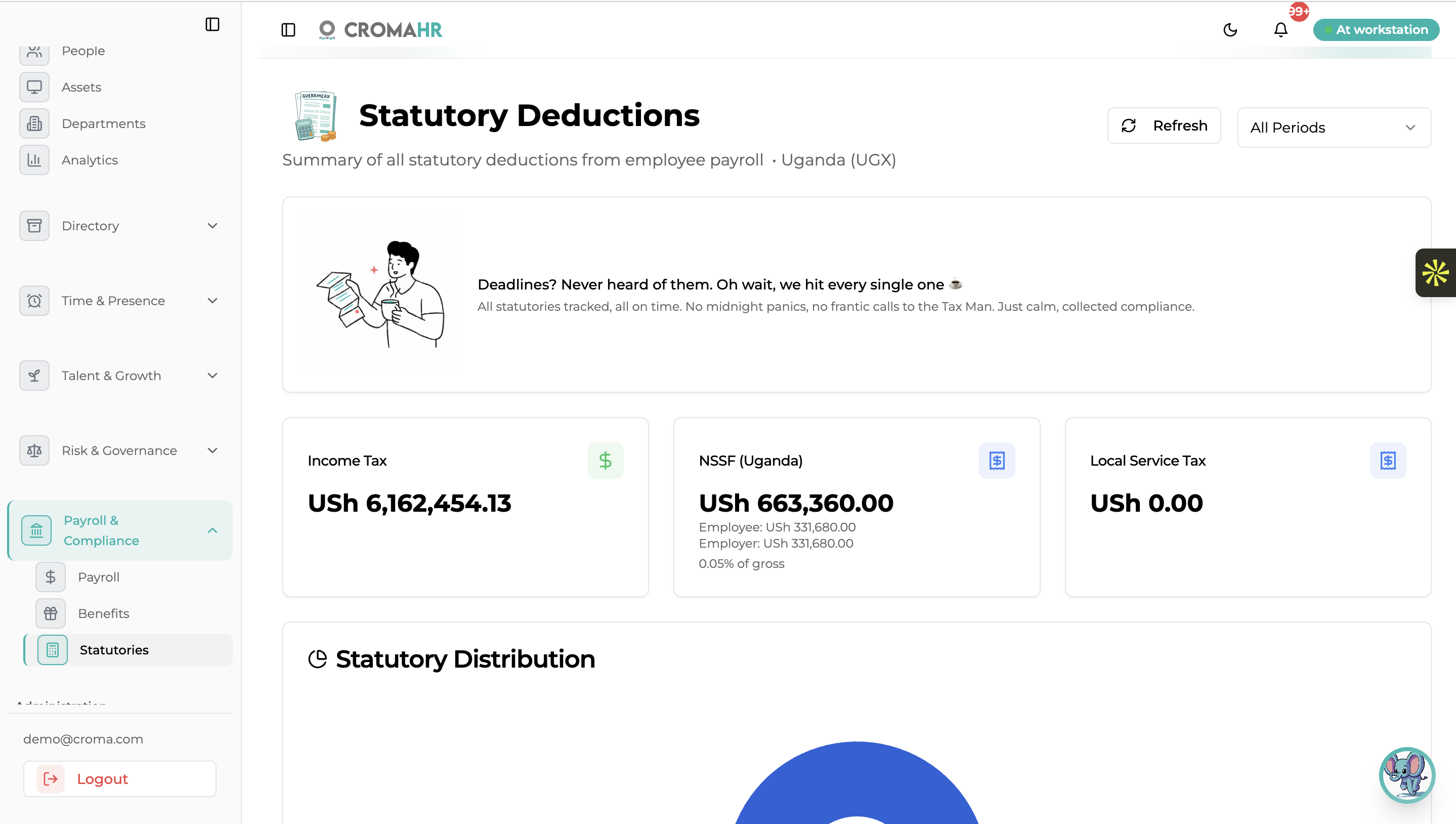
PAYE, NSSF and Local Service Tax, without the spreadsheet.

Uganda's PAYE runs from 0% up to 40% across five bands, with a zero-rated band up to UGX 235,000. NSSF is 5% employee and 10% employer above the UGX 235,000 floor, but unlike Tanzania, NSSF is not deductible for PAYE. Tax is on gross chargeable income.

Local Service Tax is handled too, capped at UGX 100,000 per year, paid in four instalments, with documented tiers from UGX 5,000 to UGX 10,000 depending on income. Non-resident employees get their own band structure starting at 10%.

The system tracks LST instalments across pay periods so you never collect too much or too little, and the annual reconciliation is a single click.

app.cromahr.com/payroll/uganda
Uganda statutory deductions in CromaHR

Tanzania

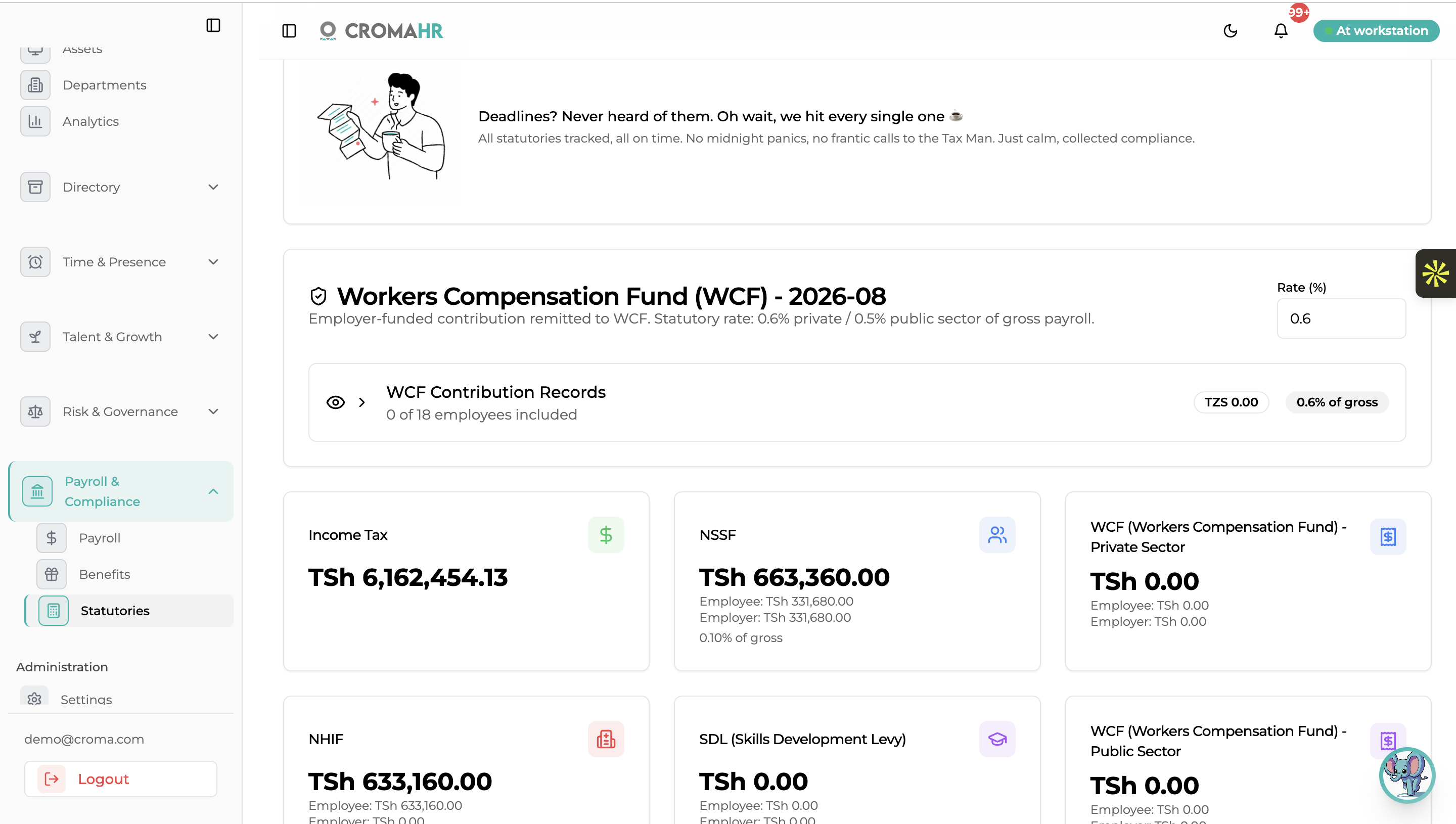
NSSF, NHIF, SDL and WCF, the full employer burden.

Tanzania has the heaviest employer-side statutory load in East Africa. CromaHR calculates NSSF at 10% employee and 10% employer (deductible before PAYE), NHIF at 3% each for public sector or opted-in employers, SDL at 3.5% for employers with 10 or more staff, and WCF at 0.6% private or 0.5% public sector.

PAYE bands run from 0% to 30% across five bands, with a zero-rated band up to TZS 270,000. The employee NSSF contribution is deductible before tax is computed, the system applies this correctly so chargeable pay is right every time.

SDL is automatically waived if you have fewer than 10 employees, and WCF rates switch based on whether you are public or private sector. No manual flags, no missed thresholds.

app.cromahr.com/payroll/tanzania
Tanzania statutory deductions in CromaHR

Ghana

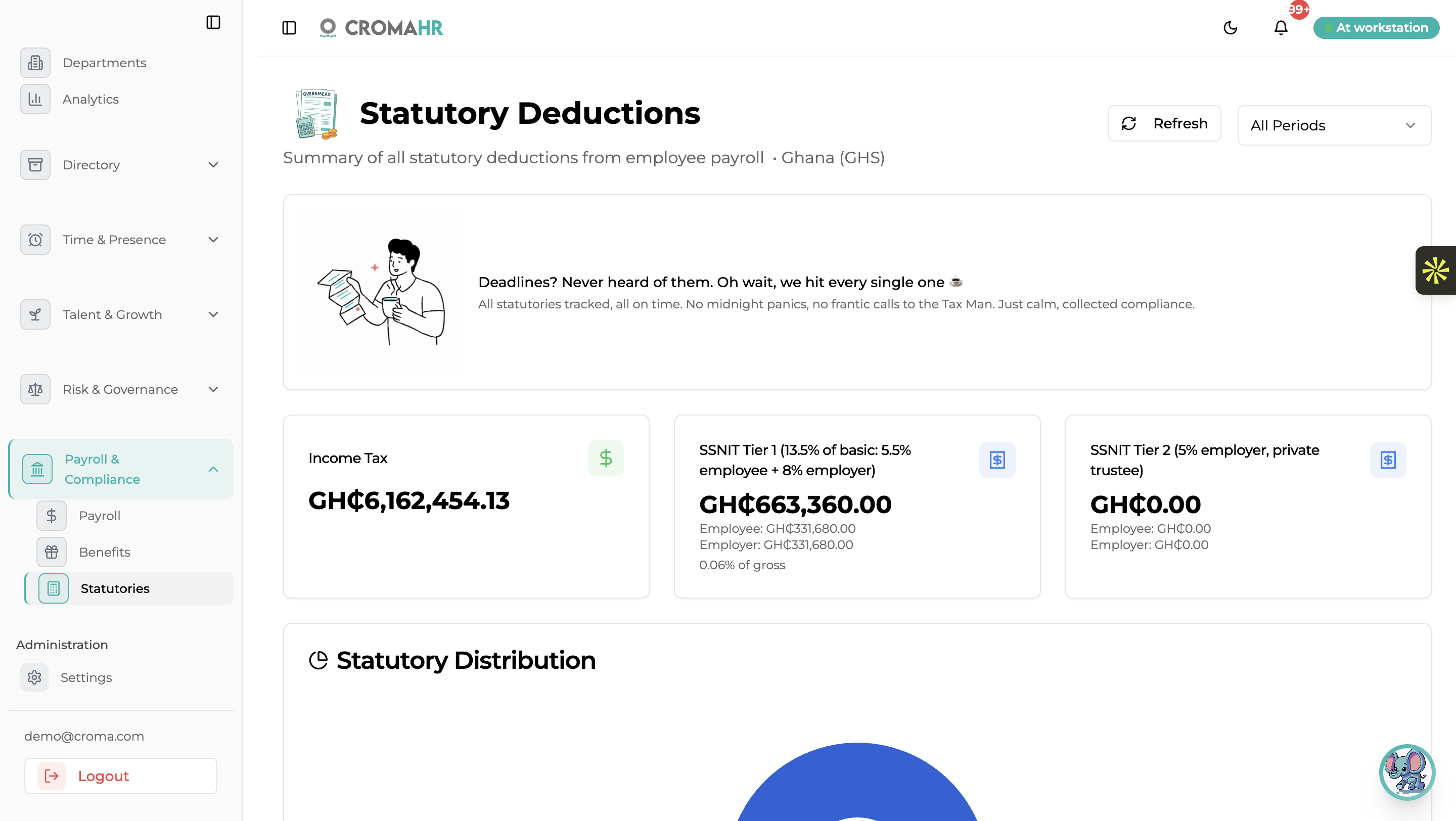
SSNIT Tier 1 and Tier 2, with PAYE up to 35%.

Ghana's social security is a three-tier structure. SSNIT Tier 1 is 5.5% employee and 8% employer, Tier 2 is 5% employer only, both calculated on a minimum base of GHS 539.19. Tier 3 voluntary contributions are deductible before PAYE.

PAYE bands run from 0% to 35% across seven bands, with the first GHS 490 zero-rated. The system handles the transition between bands automatically and applies the correct SSNIT base, so contributions are never under-paid for low earners.

Chargeable income is gross minus SSNIT Tier 1 and any Tier 3 voluntary contribution, in that order. The system respects this sequence so the tax office gets the right number.

app.cromahr.com/payroll/ghana
Ghana statutory deductions in CromaHR

At a glance

Every deduction, every country, one table.

The statutory landscape across our four core markets, side by side. Rates are reviewed against the latest KRA, URA, TRA and GRA notices each tax year.

DeductionKenyaUgandaTanzaniaGhana
Income tax (PAYE)
PAYE bands10%–35%0%–40%0%–30%0%–35%
Zero-rated thresholdUGX 235,000TZS 270,000GHS 490
Personal reliefKES 2,400/mo
Insurance relief15%, cap 5,000
Social security
Employee contributionNSSF 6% (tiered)NSSF 5%NSSF 10%SSNIT 5.5%
Employer contributionNSSF 6% (tiered)NSSF 10%NSSF 10%SSNIT 13%
Deductible before PAYE?YesNoYesYes
Health & housing
Health insuranceSHIF 2.75%, min 300NHIF 3% + 3%
Housing levyAHL 1.5% + 1.5%
Employer-only levies
Training levyNITA KES 50SDL 3.5% (10+ staff)
Workers' compWCF 0.5%–0.6%
Local Service TaxCap 100,000/yr

Rates reviewed against the latest KRA, URA, TRA and GRA notices each tax year. This table is a summary, the calculation engine handles the full rules, thresholds and edge cases.

Why it matters

The cost of getting it wrong is not the fine.

It is the time your finance team spends reconstructing six months of payslips because NSSF tiers were applied incorrectly, or the audit query that arrives three days before year-end accounts are due.

Penalties compound

Late or incorrect PAYE remittances attract interest and penalties in every jurisdiction. KRA, URA, TRA and GRA all charge for the privilege of being kept waiting, and the interest accrues monthly until it is settled.

Deadlines do not move

The 9th of every month in Kenya. The 15th in Uganda. The 7th in Tanzania. The 14th in Ghana. Miss one and the return is late, regardless of whether the money is right. CromaHR tracks every deadline and flags what is due before it is due.

Auditors want the trail

When the auditor asks "show me the NSSF calculation for June for employee 47", they want the working, the band, the rate, the cap applied. CromaHR keeps it per payslip, per period, exportable in one click.

The platform

Compliance built in, not bolted on.

Statutory deductions are not a separate module or an add-on. They are part of payroll, calculated in the same run, on the same screen, with the same audit trail. When rates change, and they do, often with little notice, we update the engine and every client is current the next pay run.

Questions

Frequently asked questions.

How quickly are statutory rates updated when they change?

We monitor KRA, URA, TRA and GRA notices and update the calculation engine before the change takes effect. Every client is on the latest rates the next pay run, no patch, no upgrade, no action required from you.

Does CromaHR file the returns for us?

CromaHR generates the returns in the correct format for each authority, P9A, NSSF return, SHIF return, SDL return and so on. Filing itself is done by your team or your accountant, but the numbers and the forms are ready to submit with no manual calculation.

What happens when an employee is in multiple countries?

Each employee is assigned a country and a tax configuration. If you have staff in Kenya and Tanzania, each is calculated under the correct jurisdiction. Cross-border assignments and secondments are handled with the non-resident band structures where applicable.

Is statutory compliance included in our plan?

Yes. Statutory calculations and returns are part of payroll, which is included from the Professional plan up. There is no separate compliance module or per-country surcharge.

Can we see the working behind a deduction?

Yes. Every payslip shows the band-by-band PAYE calculation, the NSSF tier split, the SHIF or NHIF rate applied, and the chargeable income. The audit trail is per payslip, per period, and exportable as a PDF or CSV.

What happens if a statutory deadline falls on a weekend or public holiday?

The compliance calendar automatically shifts the deadline to the next working day, per each country's rules. You see the adjusted date in your dashboard and your reminders fire three days before the adjusted deadline, not the calendar one.

Can we track compliance across multiple countries at once?

Yes. The compliance calendar shows all statutory deadlines for every country you operate in, on one screen. Filter by country, by obligation type or by month. A finance team in Nairobi running payroll for staff in Kenya, Uganda, Tanzania and Ghana sees every deadline in one view.

Does the system maintain an audit trail of compliance actions?

Yes. Every return generated, every filing prepared and every deadline met is logged with a timestamp and the user who actioned it. If the regulator asks for evidence, you export the trail as a PDF in one click.

See it on your own numbers

Fifteen minutes. One page of findings. No pitch.

We review how you handle statutory deductions today and send you a written note. You keep it whether or not you become a customer.

Get your team working with CromaHR.

Start free trial
Chat with us